

There’s a scene in the mostly forgotten 2004 sci-fi film, I, Robot, when Will Smith’s luddite, anti-robot cop character turns on the “manual override” setting of his self-driving car, and a steering wheel emerges from the console for him to take control. In the passenger seat, Bridget Moynahan, who plays Smith’s love interest/the film’s “robotics scientist” (i.e., exposition mouthpiece), turns to him and says, “You can’t be serious. Not at these speeds!”—suggesting that Will Smith is being brazen for literally doing what just about every American ends up doing every day—driving a car.
This scene was amusing in 2004. Now that there are cars that can actually drive on their own, this scene may now be thought of as… prescient?
For the better part of the first two decades of the 21st century, the self-driving car has been a big-ticket Silicon Valley goal. As early as 2014, Apple was trying to make its own electric, self-driving car, but killed the project in 2024 to focus more on AI.
Meanwhile, part of Uber’s grand strategy (one that contributed to former CEO Travis Kalanick’s downfall) involved recruiting Google’s former self-driving car team, led by Anthony Levandowski, who was later convicted of stealing Google’s self-driving trade secrets. (Trump pardoned him in 2021). According to Mike Isaac’s 2019 book Super Pumped: The Battle for Uber, Kalanick and Levandowski envisioned a world where Uber wouldn’t just receive a company cut of driver fare—with a self-driving car, they could receive the entire fare.
However, with Uber’s efforts in that arena flailing after Google made sure the company was held accountable for stealing its technology, Google’s self-driving efforts have taken the lead. In 2016, Alphabet, the parent company of Google, spun out Waymo as its own company, its name a play on the concept that it was a “way forward in mobility,” per Isaac.1
First, the Waymos were only in beta in Phoenix, Atlanta, San Francisco, Los Angeles, and Austin, where they were barred from getting on the freeway.
But now, they’re fully available for riders in those cities—and as of November 2025, Waymos can now drive on the highway, and soon they’re scheduled to be active in six more U.S. cities.
Waymo is not without its problems, just another example of self-driving cars leading to accidents, from Tesla to Uber to GM’s “Cruise” project. Some incidents have included:
Multiple occasions where Waymos have failed to stop for school buses, prompting a software recall.
A Waymo was recently recorded driving through the scene of a police standoff in Los Angeles. Crime—and the law—just doesn’t scare a Waymo.
Life finds a way—a California woman just gave birth in a Waymo.
What makes these incidents even more absurd is that in California, until a legal fix that takes effect next year, Waymos can’t be cited for traffic violations because according to state law, only people can be cited for violations.
But Waymos and their ilk do have a key advantage, particularly for women—there’s no chance of a creepy driver (or worse) when there is no driver.
On the other hand, no driver might mean there might be creepy stowaways in the trunk instead, as this recent piece in Futurism describes!
In the belly of the Waymo
I was reticent to take Waymo for a long time. One Waymo would almost always lurk on one of the cross streets from my apartment, like a video game character respawn point, waiting for its next call, its radar shifting.
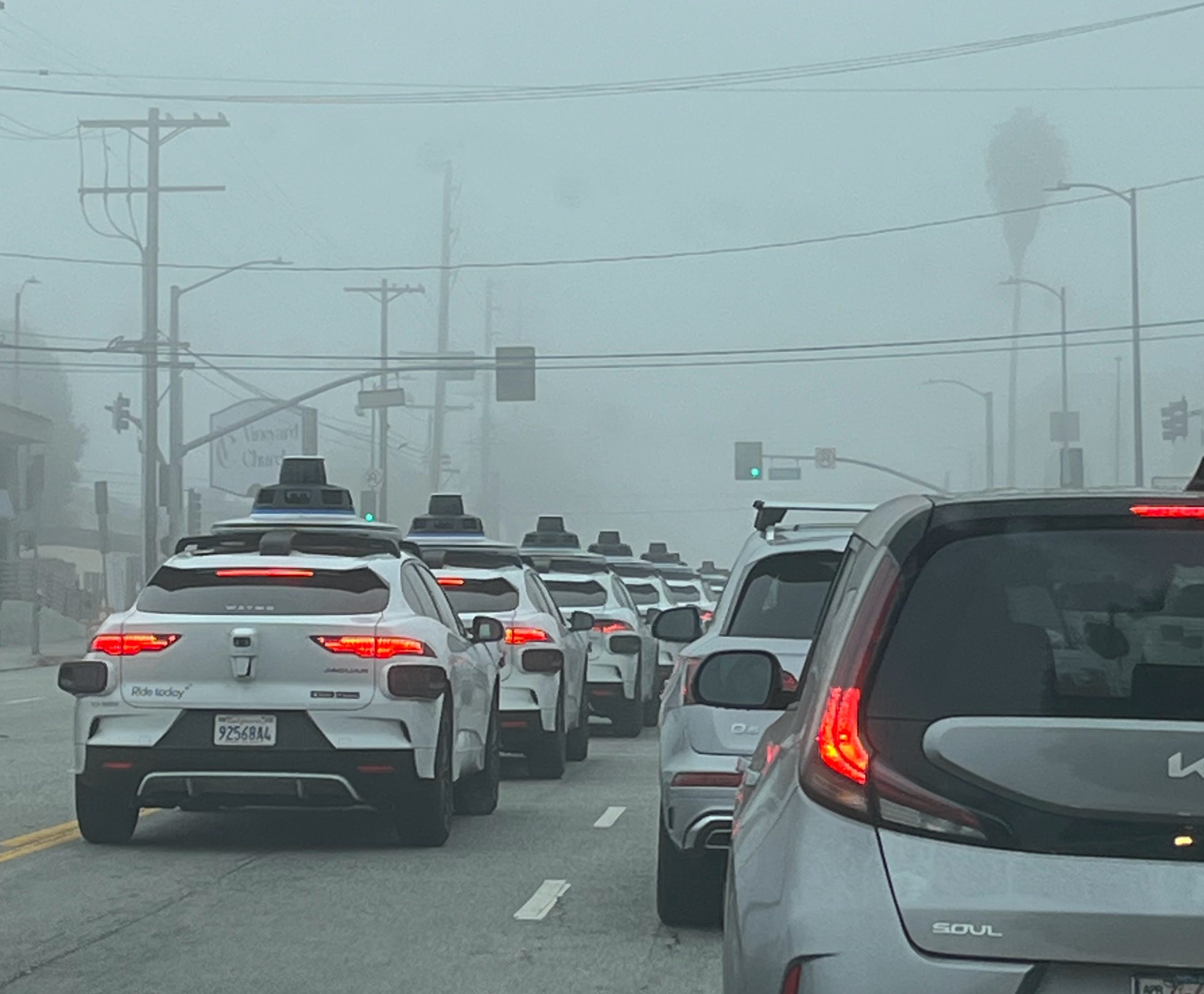
Plus, Waymos have had a curious effect on traffic as experienced in Los Angeles. Most L.A. drivers exceed the speed limit, but Waymos do not, slowing down the pace of traffic around them.
Moreover, Waymos not moving when there are obstacles can cause issues. For example, in L.A. rush-hour, the traffic box is often congested with overeager drivers trying to make it through a cycle, with their cars’ rear-ends sticking out into the right-most lane, blocking traffic that could otherwise proceed in this lane. Faced with a driver blocking the box, the Waymo will not proceed. A human, however, might wait for an opening and steer around the car in the way. But if you get caught behind a Waymo in this scenario, you may never escape the cycle… the Waymo just won’t move.
And because Waymos are equipped with all manner of sensing equipment, pedestrians have often taken a cavalier attitude toward stepping in front of them. I’ve seen people jaywalk straight in front of approaching Waymos on the assumption they’ll stop for them. While the Waymo may stop, the other drivers in the road may not. I live in fear for how many accidents and injuries this practice might cause.
Despite all my reservations, for the purposes of this post and in the spirit of “gonzo” journalism, I did take my first ride in one.
My target was modest—could Waymo take me to the community pool for my evening workout and back? The answer is yes.
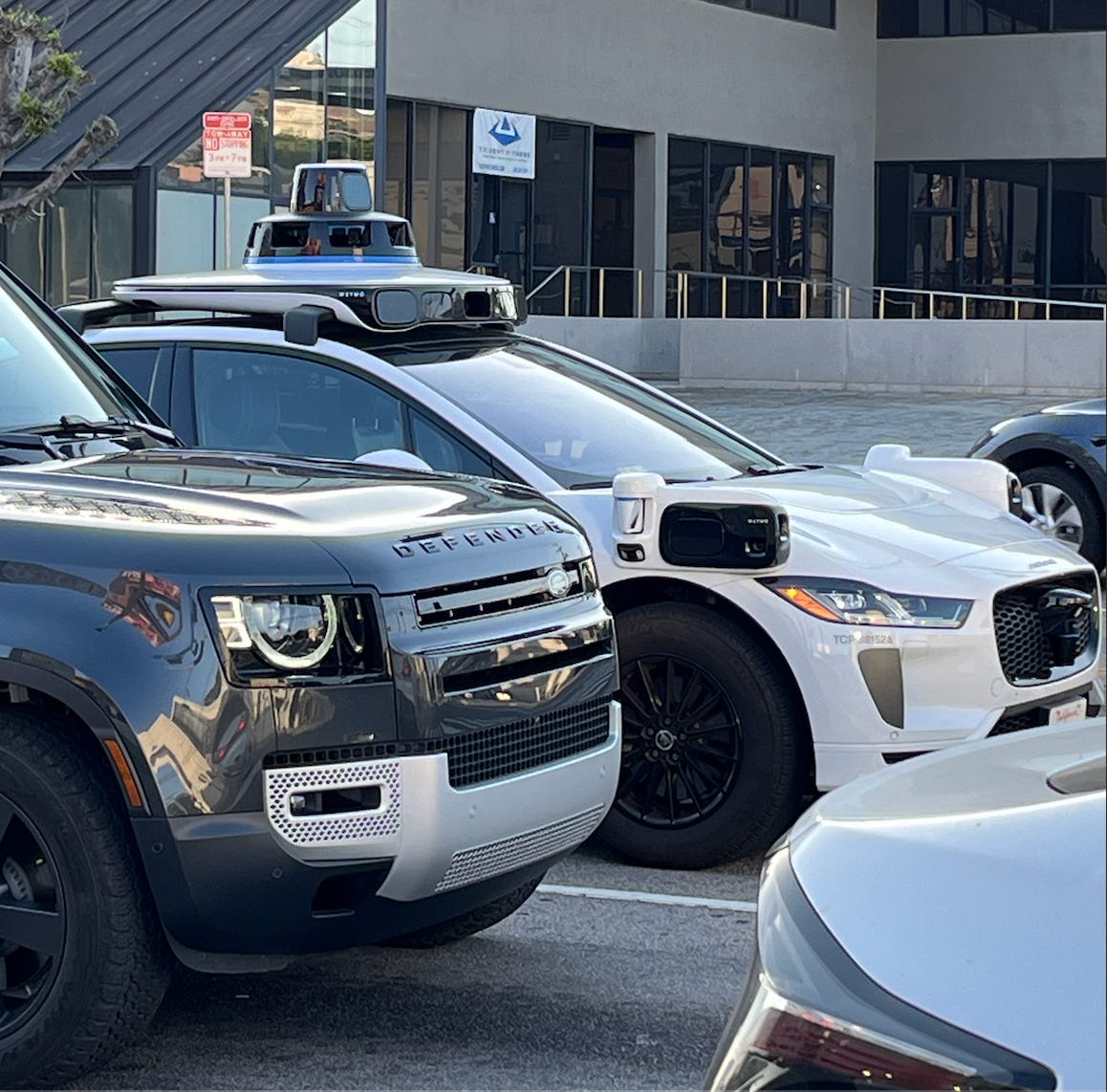
Much like Uber or Lyft, you hail a Waymo from the company’s app. When the car arrives, it idles outside the pickup point, and the whirring radar device at the top projects an icon that indicates the vehicle is in the process of picking-up.
As you approach the car, you push a button on the phone app to unlock the car, after which you can open the door. Once you’re in the backseat, the car greets you by name in a silky robotic, subway-style voice (this was weird) and a touch-screen on the console feeds you instructions—as well as the spookiest aspect of all—a live radar screen of your surroundings. Within the radar’s all-seeing vision, physical obstacles are outlined, as well as humans and other ambulant creatures, such as dogs, in motion. Police and emergency vehicles get their own color and stand out from the rest.
It’s basically like the viewscreen of malicious aliens/robots in films like Predator or Terminator, but I suppose the point is to reassure the rider that the Waymo sees all, even better than a human driver.
And this may be true for the driving. When the car dropped me off at the pool, a young man was trying to hail my robot cab. The Waymo ignored him and drove off. When the man logged the request in the app, only then did the robotaxi circle back to open the doors for him. Sometimes, a human touch is required to efficiently secure the next fare.
Mike Isaac, Super Pumped: The Battle for Uber (W.W. Norton, 2015), p. 231.
St. Louis is slated to get Waymo. We’re expecting many of them to wind up at the bottom of the Mississippi River with the scooters and community bikes.