

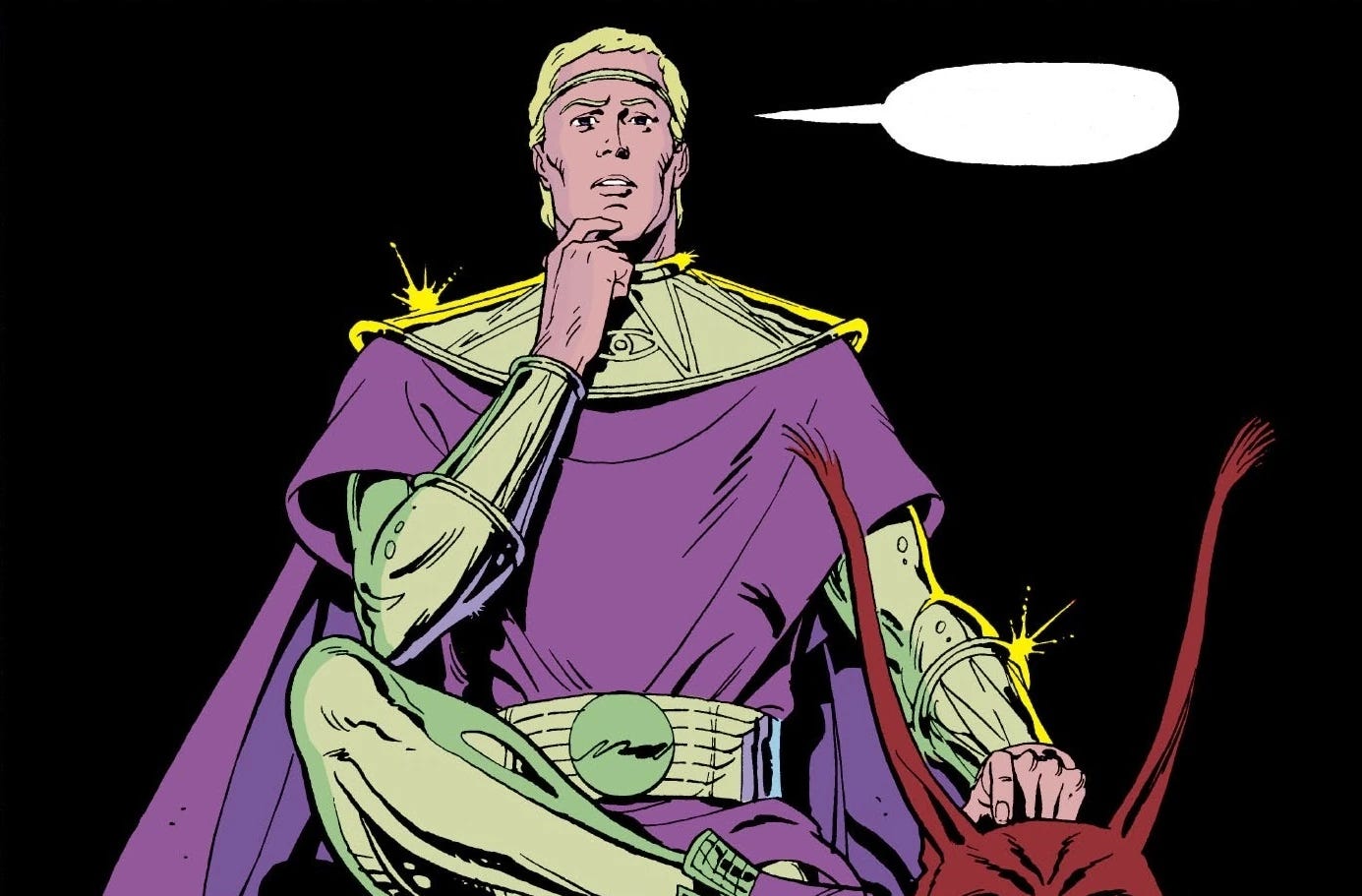
This is the twenty-sixth chapter in a long-simmering miniseries called “Narrative Architecture” about storytelling choices in fiction. There are many ways to tell a story, and in this series, I’ll examine the literary choices a particular author made and their impact on the story at hand. This week, I’ll engage with Alan Moore’s classic graphic novel, Watchmen, and how it “subverted expectations” long before Rian Johnson was getting up to his schtick.
This post is a revised version of an essay I composed as part of my MFA program at UNR.
The standard James Bond villain is a debonair mastermind who arrogantly explains his plan to the secret agent right before his plot is set in motion. The trope has been parodied many times, memorably in The Incredibles, when the villain Syndrome tells Mr. Incredible “you caught me monologuing!” But Alan Moore’s Watchmen is perhaps one of the most notable genre stories where the twist is that the villain reveals his plan after he has set it in motion.
Adrian Veidt, aka Ozymandias, is initially presented as an ally of the main cast of superheroes within the graphic novel. Set in an alternate 1980s in which Nixon is still president and superheroes have been outlawed, Watchmen follows four former “masked adventurers” after the death of one their former colleagues, “The Comedian.” Gradually, Rorschach, Nite Owl, Dr. Manhattan, and Silk Spectre realize that Ozymandias is behind the conspiracy; they confront him at his Hellenistic-Egyptian-inspired Antarctic base, at which point Ozymandias reveals his plan.
As revealed in Watchmen Issue 11, Ozymandias explains to Rorschach and Nite Owl that he plans to forestall thermonuclear holocaust by faking an alien invasion, thereby motivating the US and USSR to end hostilities and collaborate to face the extraterrestrial threat (Moore, Issue 11, p. 25).
By genetically engineering a squid monster with the aid of psychics and teleporting this monster to New York, the creature’s death upon arrival “would trigger mechanisms within its massive brain, cloned from a human sensitive… the resultant psychic shockwave killing half the city” (Moore, Chapter 11, p. 26).
This plan is of course very strange, even for the world of Watchmen (which features a naked blue Superman in the form of Dr. Manhattan). That’s probably why the squid was omitted from the 2009 Zack Snyder film adaptation and replaced by a nuclear blast meant to represent the work of Dr. Manhattan, as opposed to that of a GMO alien squid.
The plan is strange enough that Nite Owl says that Ozymandias needs “help,” and asks, “Christ, you seriously planned all this mad scientist stuff? I mean… when were you planning to do it?” (Moore, Chapter 11, p. 26). The plan is so outlandish that Nite Owl thinks Ozymandias is insane—or at least crazy in the way that mad scientist villain Lex Luthor is.
Ozymandias responds to Nite Owl by saying, quite devastatingly:
“Do it? Dan, I’m not a Republic Serial Villain. Do you seriously think I’d explain my masterstroke if there remained the slightest chance of you affecting its outcome?... I did it thirty-five minutes ago.” (Moore, Chapter 11, p. 27)
Ozymandias already set his own plan in motion; it’s too late for the heroes of Watchmen to stop him. He’s also self-aware of his actions in explaining his plan—he recognizes he’s behaved in a manner similar to a “Republic Serial Villain,” presumably a serial comic book trope in this universe.
Of course, this is what a smart Bond villain should do, if they want to succeed—explain their plan only after it is irreversible. This moment—the fact that the bad guy wins—is part of Watchmen’s lasting appeal. A realistic superhero story would have a supervillain smart enough to see through his plan to the end. Ozymandias is that villain. The ambiguity of his plan—that his mass-murder of millions of people supposedly will prevent nuclear war and therefore save lives—also adds dimension to his plot.
The 2019 HBO TV sequel series wisely brought back Ozymandias to show that such a plan cannot succeed for long, as the interdimensional squid plot (still present in this version) falls apart once Ozymandias is apprehended for his mass-murder in New York.
Watchmen still shocks readers today for its subversion of the supervillain trope. If only half as many genre entries today tried to be half as clever….