

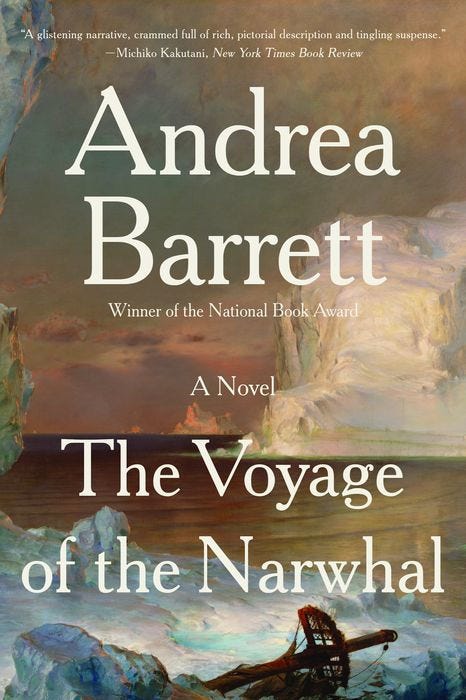
This is the twenty-third chapter in a long-simmering miniseries called “Narrative Architecture” about storytelling choices in fiction. There are many ways to tell a story, and in this series, I’ll examine the literary choices a particular author made and their impact on the story at hand. This week, I’ll engage with Andrea Barrett’s The Voyage of the Narwhal, winner of the 1998 National Book Award.
This post is a revised version of an essay I composed as part of my MFA program at UNR.
Andrea Barrett knows A LOT about polar exploration and the state of 19th century natural science. Her 1998 National Book Award-winning novel The Voyage of the Narwhal brims with references to Captain Franklin and The Terror, Antarctic explorer James Clark Ross, naturalist Asa Gray, etc. In Narwhal she crafts a revisionist narrative that both pays homage to the polar expeditions of the time and yet also challenges the less-modern aspects of those historical efforts and their contemporary scientific conventions—which often sidelined women and exploited indigenous peoples. The Voyage of the Narwhal succeeds in addressing these motives, and Barrett employs innovative narrative tactics to pull them off. However, I felt the novel suffered from the fact that the voyage of the Narwhal itself is not terribly interesting or realistic compared to more harrowing real-life tales (like that of Shackleton’s Endurance), and the novel’s latter half relies too heavily on a soap opera plot device that remains unresolved until the last second due to the overwhelming stubbornness of the novel’s would-be lovers. Narwhal, however, shows a path forward for writers who wish to craft oceangoing adventures for modern audiences.
First, let’s examine the expedition of the Narwhal. The novel’s initial protagonist is the delightfully-named Erasmus Wells, a former explorer who sees the Arctic expedition of his cocky brother-in-law-to-be, Zeke, as a way to finally become credentialed as a respected explorer after a less successful expedition to the South Pacific he had made in the past. In Philadelphia, Zeke and Erasmus leave behind Lavinia, Erasmus’ sister and Zeke’s partner, as well as Alexandra, a servant to the Wells family.
On the tiny Narwhal sailing ship, however, the story’s management of time strains some credulity. Erasmus supposedly has his first conversations with various members of the crew a few days into, or even weeks into the expedition—including the cook, Ned (described as on “day 4”) (page 46) and Erasmus’ scientific colleague, the physician Dr. Boerhaave (page 54), at least two weeks into the expedition (the timing is unclear). All these conversations, realistically speaking, would be happening on Day 1 or 2, or maybe before, during the crew interview process. I kind of laughed when I read every time that Erasmus was just meeting someone on the ship—halfway to the North Pole—for the first time. What has Erasmus been doing all day long for weeks, if not talking with the other half-dozen people on the boat? In Narwhal the technique is especially laughable because the ship is so small, and even class differences between the crew and the officers, as the novel points to as a reason for their segregation, are not reason enough to make sure that all the officers have not met each other.
During the early sections of the novel, Barrett weaves between different POVs by citing the diary entries of Ned the cook and Dr. Boerhaave to complicate the spacey, Erasmus-centric perspective, a tactic I admired, which also had the added effect that The Narwhal seemed like a real expedition and that authentic diaries had been compiled to write the book (as was the case in many famous books of polar exploration). Most innovative is Barrett’s decision to set up and keep tabs on the character of Alexandra through her diaries, one of the women left back home, because she becomes the driving force of the novel once Erasmus returns as a broken and depressed (and honestly total buzzkill of a) character. From Alexandra’s diary:
I lie in the dark and dream about that place and those people. I’d give anything to be with Zeke and Erasmus. Anything. I’m grateful for this position but sometimes I feel so confined—why can’t my life be larger? I imagine those Esquimaux befriended by Parry and his crew: the feasts and the games, the fur suits, the pairs of women tattooing each other; gravely passing a needle and a thread coated with lampblack and oil under the skin of their faces and breasts. I dream about them. I dream about the ice, the snow, the ice, the snow. (Barrett 86)
Back in Philly, Alexandra finds her own form of empowerment in secretly editing and typesetting a book written by a polar explorer, whereby she gradually expands her range of knowledge and expertise in publishing and science. Her smaller story, for much of its length, seems far more interesting than that of Erasmus, who spends most of the novel depressed and conflicted about betraying a dreadful personality in the form of Zeke. Rather, Alexandra expresses the strange and paradoxical urges which drive explorers to the poles, the Romanticism as laid out by Shelley’s polar explorer Walton in Frankenstein.
Eventually, due to some poor decision-making on the part of the vain and cowardly Zeke, the Narwhal gets frozen and trapped within the Arctic icepack, in homage to the contemporary lost ships The Terror and The Erebus and that of Shackleton’s later Endurance. By the time Erasmus abandons a missing Zeke in the Arctic and endorses the plan to abandon ship, the novel is only halfway over. As a result, an astute reader will expect Zeke’s return in a totally obvious Dickensian plot twist later in the book. So it is quite a subversion on the part of Barrett that a book titled The Voyage of the Narwhal extends far beyond that initial expedition and instead proceeds to investigate the legacy of that failed expedition and the climate of scientific racism in 19th century natural science.
Having spent some time studying the history of problematic 19th century earth scientists such as Louis Agassiz and Arnold Guyot (and have since then unexpectedly found myself in conversations with an ad-hoc inter-university task force to educate earth scientists about these figures’ less admirable qualities), I can say that Barrett nails this aspect dead-on.
She accomplishes this well in the episode when Zeke returns to Philadelphia, with his Inuit lover Annie and her (their?) son Tom, he goes on a lecture tour parading around the “Northern savages,” including a stop at the Smithsonian in Washington. In an effort to rescue the ill Annie and Tom from Zeke’s scientific abuse, Erasmus visits the Smithsonian and encounters a display of artifacts from Fiji peoples, gathered from a previous expedition in which he himself took part:
Case 71.
Collections made by the U.S. Exploring Expedition in the Feejee Islands… Cannibal Cooking Pots.
The Feejees are Cannibals. The flesh of women is preferred to that of men, and that part of the arm above the elbow and the thigh are regarded as the choicest parts. So highly do they esteem this food, that the greatest praise they can bestow on a delicacy is to say that it is as tender as a dead man…
[Erasmus] leapt back as if he’d been burned. He both and couldn’t remember those objects, and the young version of himself who’d helped gather them. Two members of the Expedition had been killed by those Feejee Islanders. He hadn’t taken part in the retaliatory raid, but he’d known what was happening. From the ship he’d seen the smoke from the burning villages and heard the rifle fire. Wilkes had argued that man-eating men deserved any punishment he might inflict, and although Erasmus had hated Wilkes’ harsh ways with the native peoples, in this case part of him agreed. But that had been before Dr. Rae returned from the arctic with the first news of Franklin’s fate, and those hints of mutilated corpses and human parts found in the British cooking kettles. Before Joe told him about the British boot. (Barrett 350-351)
This scene is an interesting way to address a character coming to terms with his complicity in imperialism. At its worst moments, it strikes me as very unrealistic for the time period for a character to be so enlightened, sort of like Tom Cruise’s cringey flashbacks of participating in what seems to be the Massacre at Wounded Knee in The Last Samurai or Gerard Depardieu’s laughably inaccurate portrayal of Columbus trying to protect the Taino Indians from his more rapacious Spanish colleagues in Ridley Scott’s misbegotten epic, 1492: Conquest of Paradise.
But here, Erasmus’ development is tied to his revelation, in the novel, that even the British explorers of the doomed Terror/Erebus expedition resorted to cannibalism, rendering the American judgement of the Fiji islanders overly harsh and hypocritical. To some level, Erasmus is also realizing that massacring natives is just as high a moral crime as consuming human flesh. To address Erasmus’ evolution, ironically I’ll quote Roger Ebert regarding that Columbus movie: “I am not convinced that Columbus was as enlightened as he seems in this movie, but perhaps historical figures exist in order to be reinterpreted every so often in terms of current needs” (Ebert). Erasmus is therefore a historical reimagining of a polar explorer character to reflect the more revisionist approach to history that Barrett is interested in pursuing, which makes the Narwhal more relevant to modern audiences.
Barrett develops that angle further, and most harrowingly, when she briefly peaks into Annie’s perspective as she is dying, when she realizes that her skeleton will be placed in the Smithsonian for future phrenologists to examine:
Annie was in a room….No one would listen to her. Not the doctor, not Zeke; not even Erasmus, who’d asked what she needed but then turned his back and disappeared when she’d said, I want to go home. Wasn’t that what she’d said? Her body would never go home now and she must do what she could for her son. A white cloth over the bed, white cases over the pillows; she had little time; she worked. The great power, the angekok [medicine man] had once told her, comes only after struggle and concentration. By the strength of her thought alone, she must strip her body of flesh and blood and be able to see herself as a skeleton. Each bone, each tiny bone, clear before her eyes. Then the sacred language would descend, allowing her to name the parts of her body that would endure. When she named the last bone she’d be free; her spirit could travel and she could watch over her son. She burrowed under the white cloth and squeezed shut her eyes, beginning the terrible process of shedding her flesh. Let me be bone, she thought. Like the long narwhal spines at home, the walrus skulls, the delicate ribs of the seals. White bone. (Barrett 363)
This is a striking section because it is one of the only moments which delves into Annie’s interiority and sympathizes with her plight more directly. It also alludes to a supernatural/ “Noble Savage” undertone regarding the Inuit characters that skews a bit too Dances with Wolves (ugh) for my taste. But this moment is critical, because it lays bare the horror of what the explorers have done to this Inuit woman. They have brought her out of her context, into a climate to which she was ill-prepared, and now she will die at the hands of Western doctors (who are still really bad at medicine at this point in history), and finally her bones will be treated as a prop in a museum.
Despite this profundity, the Narwhal gets a bit exasperating as the final section relies on a “will-they/won’t-they” romance between Alexandra and Erasmus. By this point in the novel they are living in a cabin in the woods together, so for their first sexual encounter to be ten pages from the ending, feels a bit intentionally delayed:
On April 26, late at night, Alexandra walked into his room. Twenty-two buttons down the front of her gray dress; she unfastened the first six, as simply as if she were shedding her dress for her painter’s smock. Erasmus undid the rest. The first sight of her bare shoulders struck him like his first sight of ice—how could he have forgotten that? (Barrett 386)
In this scene I find it kind of amusing (and also interesting) that Barrett makes the Freudian leap that an explorer’s attraction to the ice is the same desire he feels for a woman. Whereas other texts might retain this idea as a subtext, Barrett makes this idea (the phallic act of “exploration”) explicit. However, Erasmus and Alexandra’s new union allows Alexandra to join Erasmus as his explorer-wife as they try to return Tom to his homeland at the wish of Annie, who may (or not) be literally haunting them as an Inuit ghost. It does seem like a fraught plan regardless, as there’s no guarantee Tom will be welcomed back to a community he left as a child. But it is a Romantic ending, wherein the explorer goes off into the misty ice and disappears, just like what happens to Dr. Frankenstein and his monster at the end of their book.
Overall, Narwhal succeeds as a revisionist adventure novel that takes aim at the problematic ideologies which promoted these historical explorations in the first place. It’s a soap opera, but then again, Dickens succeeded by drawing from the drama of glacial love stories and unexpected reappearances, and it’s a strategy that still works today.
Works Cited
Barrett, Andrea. The Voyage of the Narwhal (W. W. Norton & Co.: New York, 1998).
Ebert, Roger. “1492: Conquest of Paradise,” RogerEbert.com, October 9, 1992, https://www.rogerebert.com/reviews/1492-conquest-of-paradise-1992
Zwick, Edward (director). The Last Samurai (Warner Bros., 2003).