

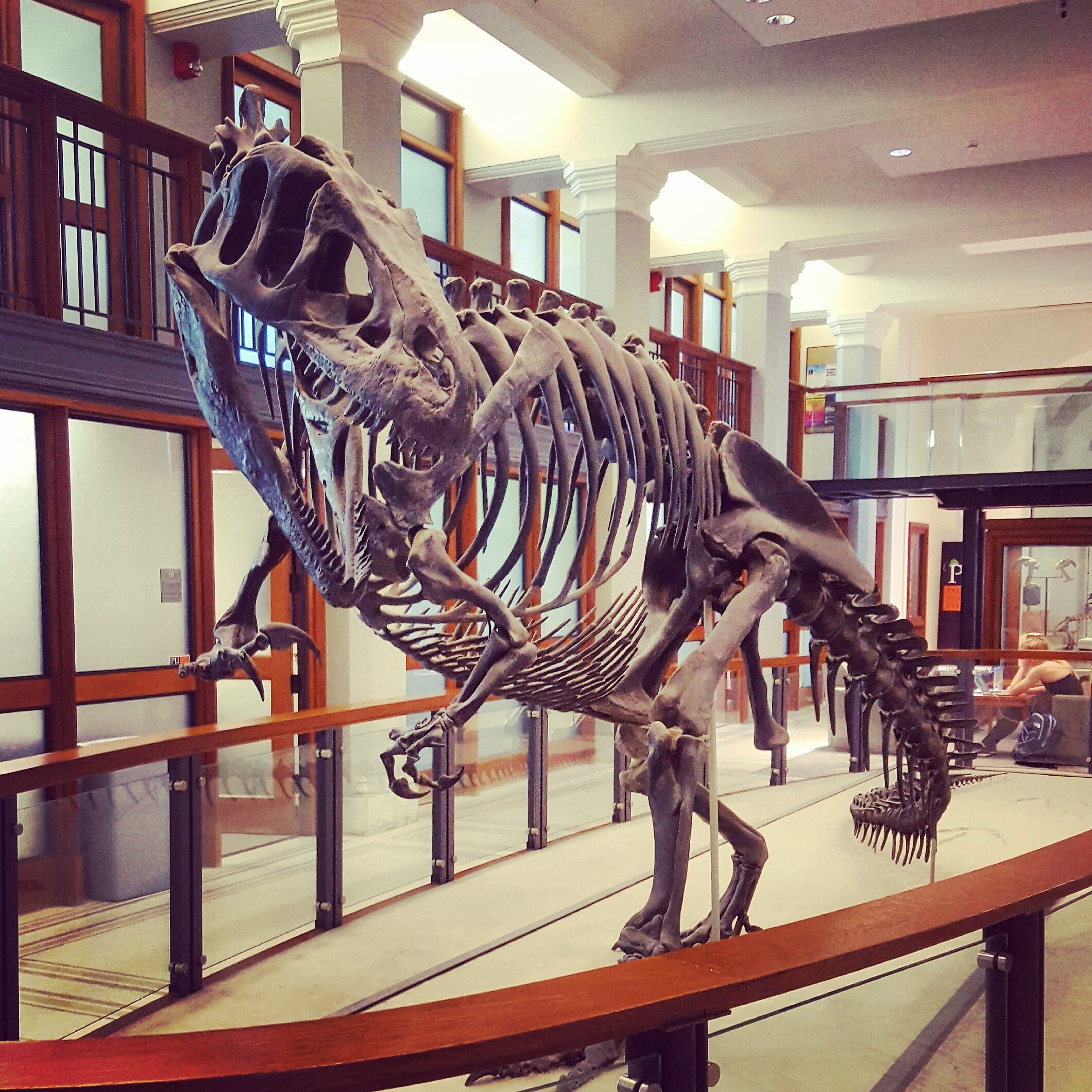
The following is a feature story I wrote in 2016 for a college journalism seminar about the 2001 dismantlement of the Princeton Guyot Hall museum. Now that it’s been ten years, a few of the subjects have passed on (Henry Horn and Jerry Ostriker among them); meanwhile, the famous Antrodemus skeleton (above image) has been relocated to the new earth sciences complex in 2025, as the historic Guyot Hall has begun its conversion from an earth science building to one devoted to computer science.
PRINCETON, NEW JERSEY—In late May, Princeton is often hot and humid. In 2000, it was strangely pleasant, with temperatures barely reaching 75 degrees, weather somewhat unusual for Reunions, a three-day long celebration filled with startling displays of inebriation. Apocryphally, it’s known as one of the largest beer orders in the world. But for a few geoscience department alumni, it was a crystallizing moment of a crisis. Following the departmental reception, a half-dozen alumni sat down and wrote letters to the then-University President, Harold Shapiro.
“People were very distrustful,” Geoff Feiss said, class of 1965, and a former provost of the College of William and Mary. “There was this feeling, I think Princeton was being a little too elitist and not too concerned with school-kids.” In March 2000, the University presented architectural plans to a Geoscience faculty meeting that announced the Guyot Hall Museum would soon close its doors for good. Over the summer the exhibits would be boxed up to make way for office space for the then-new Princeton Environmental Institute, a decision that aimed to radically changed the character of Guyot Hall, designed to be a museum at its construction in 1909.
“It was kind of a rebellious feeling, taking a stand on this,” Nancy West said, Feiss’ wife, and a geosciences major from the class of 1979 who took part in the letter-writing campaign. “It was a welcome break. You don’t go to Reunions hoping to accomplish something.” West contrasted the action to writing to a congressperson. “Senators don’t pull heartstrings, but Princeton does.” Over the summer of 2000, the conflict between museum supporters and the University erupted into a controversy that divided the community and attained national media attention. At stake was an illustrious legacy in natural science and a treasured local resource. Facing extinction, only a few relics survived.
The last of its kind
Though only a few artifacts survived the museum battle intact, you can find them in Guyot Hall, if you know where to look. Visit Guyot Hall today, and you might notice the shaved-off boulder that rests outside the entrance, a relic that helped prove the existence of the last Ice Age. After opening a great wooden door, you ascend a green stone staircase, its steps worn down with a century of foot traffic. The building’s main floor is a vaulted gallery. A mezzanine wraps around the building’s interior, and offices peek behind the elevated walkways, giving an anachronistic sense of a Victorian airplane hangar. Along the walls of the Geosciences wing, gems and minerals haunt a few display cases. Two overshadowing figures of Princeton geology eye the scene: mounted portraits of Arnold Guyot, the 19th century Swiss-American geologist, and Henry Hess, the founder of plate tectonics.
Walk past a great glass globe, into the office space of the Princeton Environmental Institute and further, to the Department of Ecology and Environmental Biology, and you see another vision of the past: a dinosaur. The mounted Allosaurus skeleton lurks in the center of the room. (For Princeton geologists, it was Antrodemus, but Yale’s name was the one that caught on—fitting, given that Allosaurus in Greek means “the other lizard”). The extinct carnivore resembles a smaller version of its more famous descendant, the Tyrannosaurus. The creature began the transformation to stone when it died 150 million years ago in what is now the Western United States. It was unearthed in 1941 and installed twenty years later. There it has stayed, while itsneighbors have come and gone.
Today, few undergraduates know that Princeton University was the second institution to display mounted dinosaur skeletons in the world. They also might not realize that Princeton had been home to a natural science museum for about 125 years, and they might be more shocked to learn that this museum existed as recently as 2000.
This history is writ in the little objects scattered around Guyot Hall—the minerals, the boulder, the portraits, the dinosaur. The writer John McPhee, who has an office in Guyot, once called the Allosaurus yet another name: a ‘tokensaurus.’ For perhaps more than once in its existence, that dinosaur has been the last of its kind.
