

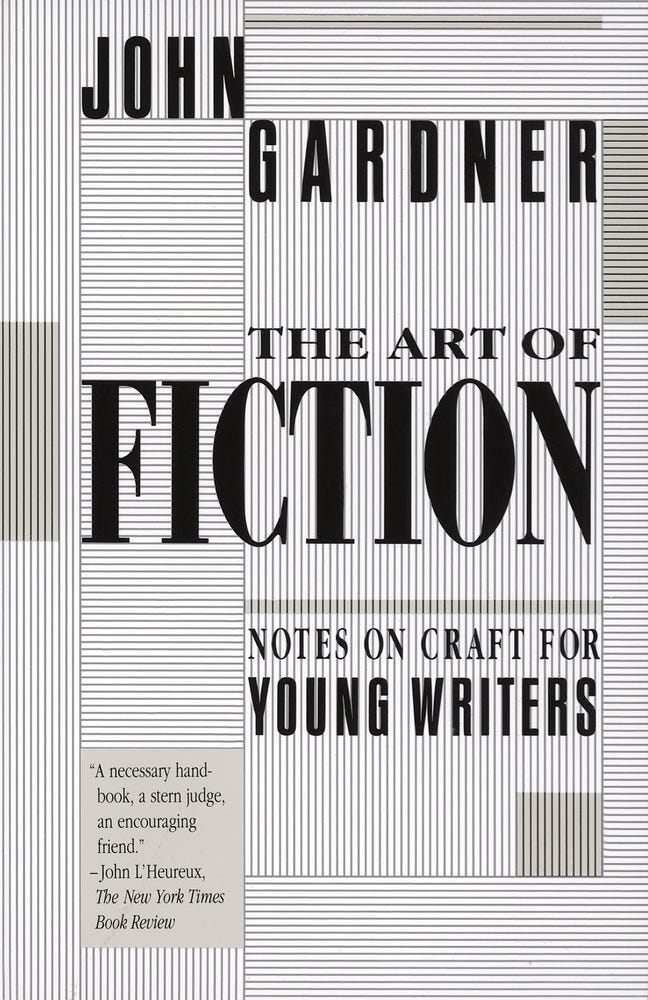
This is the twenty-fourth chapter in a long-simmering miniseries called “Narrative Architecture” about storytelling choices in fiction. There are many ways to tell a story, and in this series, I’ll examine the literary choices a particular author made and their impact on the story at hand. This week, I’ll engage with John Gardner’s classic craft book The Art of Fiction, influential but perhaps in need of an update.
This post is a revised version of an essay I composed as part of my MFA program at UNR.
On September 14, 1982, John Gardner died in a motorcycle crash. He was only 49. At the time, his third marriage was fast approaching—and his career was falling apart. Through his harsh criticisms of his contemporaries, such as Philip Roth and Saul Bellow, Gardner had alienated himself from the literary community. Today, his most remembered novel is Grendel, his subversive retelling of Beowulf. Of his few books which have remained in print, it is somewhat ironic his craft book—in which he expressed his disdain for his fellow writers—has withstood the test of time. The Art of Fiction was published posthumously in 1984, and has since become a staple text for writers starting out.
Notwithstanding Gardner’s opening note expressing the apparent futility of teaching writing to an audience that may not have the “gift” (“What is said here, whatever use it may be to others, is said for the elite; that is, for serious literary artists” (Gardner x)), the haughty author did offer some useful craft observations. Gardner’s text is split into two parts. The first section is characterized by Gardner’s opinions on literary theory; the goals a writer for which a writer must strive. These most prominently include his emphasis on “fiction as dream”:
If we carefully inspect our experience as we read, we discover that the importance of physical detail is that it creates for us a kind of dream, a rich and vivid play in the mind. (Gardner 30).
I agree that a lot of good fiction creates this “dream” in the mind, but in my experience, I would describe it more akin to seeing a movie in your head. When I write, I see a movie in my head that I am then trying to transcribe and translate into prose so that others can “watch” the movie I’m witnessing. That being said, for the purposes of this piece, I will focus mostly on craft techniques detailed in the second section of Gardner’s book, because that section focuses on mechanics. It explains how writers can craft this dream/movie with their prose—and the “common errors” of novice writers that disrupt the ‘dream-weaving’ process.
“In bad or unsatisfying fiction, this fictional dream is interrupted from time to time by some mistake or conscious ploy on the part of the artist,” Gardner wrote. “We are abruptly snapped out of the dream, forced to think of the writer or the writing. It is as if a playwright were to run out on stage, interrupting his characters, to remind us that he has written all this” (Gardner 97). Gardner used this concept, that of a writer interrupting his own work, in his explanation of the problems of the ‘common errors’ of novice writers. But I think the idea also applies to metafictional techniques that, when sloppily executed, alert readers to the artifice of the work in general, an opinion Gardner expressed at a later moment in his book:
On one hand, showy technique is thrilling… On the other hand, cleverness can become its own end, subverting higher ends, as when style overshadows character, action, and idea. (Gardner 134-135)
I think about this problem a lot. Once I wrote a neo-noir story in the voice of Raymond Chandler. My writing instructor at the time recommended I read Jonathan Lethem’s Motherless Brooklyn, a work of literary fiction that satirized Chandler’s voice and put it in the head of a detective with Tourette’s.
I ended up disliking Motherless Brooklyn because the text was constantly acknowledging that the whole thing was an extended joke—that Raymond Chandler’s iconic hardboiled voice was nothing more than something to mock, a ridiculous tone that only a narrator with a disability could possess. By constantly acknowledging its own artifice, Lethem’s novel seemed to shoot itself in the foot. But since the time of Motherless Brooklyn (1999) (later adapted as a much-maligned 2019 film)—the whole “meta” thing has gone mainstream, and now most popular movies, especially Marvel and Disney ones, constantly make jokes at dramatic moments. In an echo of Gardner’s sentiments, the effect was concisely summed up by YouTuber Sage Hyden:
“What moments like these signal to me is that the creators don’t have confidence in their own stories. They’re using the joke to distract from the film’s dramatic shortcomings.”
Because my fiction is often playing with genre tropes, whether they be pulp thriller, gothic horror house, or hardboiled detective, the key for me then becomes how to balance “subject and presentation,” as Gardner points out (135). To deal with genre clichés in a way that is smart, but not overly clever or drawing attention to itself—ways in which lesser Thor–type movies get away with, well, lackluster narratives.
The element of what Gardner calls psychic distance—the level of identification the narrator takes with a character—comprises an important way the “dream” can be effectively expressed, or alternately, disrupted. As Gardner expresses:
In good fiction, shifts in psychic distance are carefully controlled. At the beginning of the story, in the usual case, we find the writer using either long or medium shots. He moves in a little for scenes of high intensity, draws back for transitions, moves in still closer for the story’s climax…. A piece of fiction containing sudden and inexplicable shifts in psychic distance looks amateur and tends to drive the reader away. (Gardner 112)
It is interesting that Gardner describes psychic distance’s levels in the language of film (“long or medium shots”). In so doing, he expresses the need to vary distance between what is told more abstractly to the reader and what is demonstrated in scene, and to also vary where the camera is positioned, whether the camera is from one character’s immediate perspective or zoomed out entirely.
What does Gardner have to say about suspense, then?
Ideally, every element in the lead-in passage should be a relevant distraction that heightens the reader’s anticipation and at the same time holds, itself, such interest…that the reader is reluctant to dash on.
I like how Gardner refers to supporting detail as a “relevant distraction,” and I think it might be useful to think of all ancillary details as “relevant distractions.” Relevant in that they set up or support the plot or character at hand, but also in that they fill in the gaps in the reader’s dream. Also key to Gardner’s analysis is that suspense is not just the motivating urge to keep reading, but suspense in the sense of suspended—the reader cannot go forward or backward without following the path of ropes and pulleys you’ve laid out for them. It is as much keeping the reader involved in the relevant distractions as getting them to turn the pages.
In a further elaboration of Gardner’s conception of suspense, I wanted to highlight what Gardner characterizes as the “Sartrian anguish of choice:”
That is, our suspenseful concern is not just with what will happen but with the moral implications of action. Given two possible choices, each based on some approvable goal, we worry, as we read, over which choice the character will make and, given the nature of reality, what the results will be.
To be involved in the suspense of the story or dream, a reader must worry about the consequences of what may happen to a character. The stakes of a character’s decision help crystallize the reader’s concern about the character’s fate. Another one of my writing mentors called this the “hope–dread” axis. A reader may hope a character makes the “right” decision, but he or she must also dread the consequences of the “wrong” one. In this way, a reader is involved on two emotional levels: fear and hope, both extremely powerful attachments crucial to supporting the dream.
When I write, I try to keep the hope–dread axis in mind when establishing stakes. What should I want the audience to hope? What should the audience know to fear? Often when a story isn’t working—the dream flawed and distracted—it is usually because one of these elements is not clear enough.
Gardner may have left the world unceremoniously and on bad terms, but aside from his potshots at other authors, much of his advice still holds. As long as novice writers such as myself struggle with psychic distance and suspense, The Art of Fiction and its advocacy of the “fiction as dream” will have its uses.
Works Cited
Gardner, John. The Art of Fiction: Notes on Craft for Young Writers. Vintage Books edition. New York: Vintage. 1991.
Hyden, Sage. “What Writers Can Learn from Wonder Woman.” JustWrite. YouTube. June 23, 2017.
Pfeiffer, Ben. “John Gardner’s Tricky Death and Tangled Legacy.” The Paris Review. September 14, 2017.
Lethem, Jonathan. Motherless Brooklyn. New York: Vintage. 1999.
Stanton, David. “Between the Lines.” The Washington Post. July 16, 2006.