

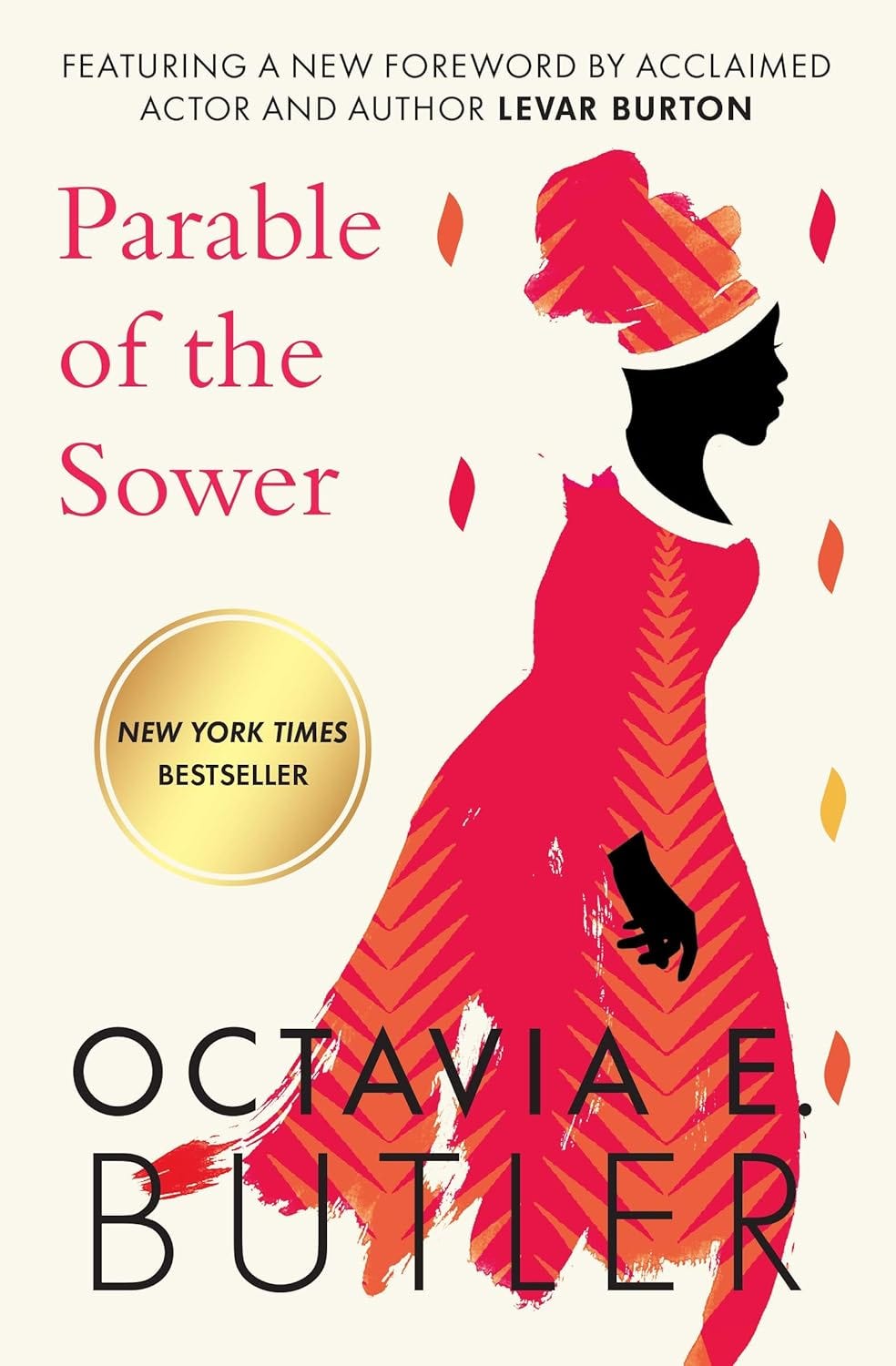
This is the twenty-seventh chapter in a long-simmering miniseries called “Narrative Architecture” about storytelling choices in fiction. There are many ways to tell a story, and in this series, I’ll examine the literary choices a particular author made and their impact on the story at hand. This week, I’ll engage with Parable of the Sower, Octavia Butler’s classic, trailblazing work of science fiction, which imagines a Los Angeles on fire, engulfed in encampments, and falling into anarchy thanks to an ineffective and corrupt administration in Washington. Sound familiar?
This post is a revised version of an essay I composed as part of my MFA program at UNR.
Octavia Butler’s now-classic Parable of the Sower depicts a Los Angeles on fire, taken over by lawless homeless camps and ineffectually governed from afar by an American president who wants to restore America to some sort of former glory. If I wasn’t reading the “science fiction” label on the book, then this would essentially describe Southern California today.
Butler’s modest origins and trailblazing position as a woman of color in science fiction add further prestige to this work. Taken all together, I thought this was a deceptively difficult text which might have benefitted from some minor editorial adjustments. Nevertheless, the book’s vision of Southern California in collapse is quite influential and prescient. Finally, perhaps the weaknesses and questionable elements of Parable of the Sower in fact represent its strengths.
Thanks to a medication-caused birth defect, Butler’s teenage protagonist Lauren Olamina possesses supernatural abilities which allow her to feel the emotions of people she interacts with. This also helps account for Lauren’s precocious voice, which definitely reads as jarring and did not entirely convince me of its verisimilitude:
At 13, my brother Marcus has become the only person in the family whom I would call beautiful. Girls his age stare at him when they think he’s not looking. They giggle a lot around him and chase him like crazy, but he sticks to Robin. She’s not pretty at all—all skin and bones and brains—but she’s funny and sensible. In a year or two, she’ll start to fill out and my brother will get beauty along with all those brains. Then, if the two of them are still together, their lives will get a lot more interesting. (Butler 123)
Theoretically, Lauren is a teenager who is commenting on her brother’s growth and development, yet her commentary reads like that of someone much older, who has seen this pattern of human development time and again. In N. K. Jemisin’s introduction of my copy’s edition, Jemisin writes that she also thought that “[Lauren] always read to me like an older woman’s idea of what a smart teenager should be, rather than a realistic rendering of what teenagers are actually like. Naturally, I like her better the older I get” (Butler ix).
I think Jemisin’s point helps me articulate why I have been resistant to a lot first-person voices for this reason. With the possible exception of J. D. Salinger’s Zooey, who leaps off the page despite the unlikeliness of his genius, whenever I see a teenage character speaking directly to the reader I have my doubts that the teenage character could speak in such a stylized affect.
On the other hand, would I want to read Parable of the Sower in the voice of an actual, realistic teenager?
The answer is—probably not. This is the challenge that Butler faced, and so she gave Lauren special abilities which help establish her role as a Joan of Arc-type in establishing her cult-commune centered around the beliefs of “Earthseed.”
And just because a book is about a young character doesn’t make it YA. In this book, Lauren Olamina witnesses a lot of graphic violence and death, and even engages in a sexual relationship with a 57-year-old man, Bankole. You know it’s never good when a character reacts this way after having sex:
“You’re a kid,” he said. “I ought to know better. How old are you, anyway?”
I told him.
He jumped, then pushed me off his shoulder. “Eighteen?” He flinched away from me as though my skin burned him. “My god,” he said. “You’re a baby! I’m a child molester!” (Butler 267)
Yikes? Butler’s work seems to be committed to showing how traditions and social mores break down in the face of ecological collapse. Lauren’s relationship with Bankole feels like an inverse of the more conventional cult leader depicted in Gold Fame Citrus—in Lauren’s view, her relationship with Bankole is empowering. However, her status as a young woman makes the power dynamic different than that of Levi in Claire’s book, and I don’t really know how to break down Lauren’s position except to determine that she is a character who, finding a void and weakness in the dying American order, crafts her own religion, belief system, and social values to suit her needs.
Her super-powers / mental illness in the form of “hyperempathy” also make her a Christ figure in that, like other historical prophets (Joan of Arc), some mental instability might be interpreted by others as divine visions. So this book, while delving in territory often frequented by YA (dystopia, messiah character, young person’s voice), can be read in many ways and therefore is what I might call “deceptively straightforward,” a text that is revealed to be more challenging the more one interrogates it.
I want to briefly address the pacing of this novel, which takes a long time to get going. Like To Kill a Mockingbird, the episodic nature of Lauren’s childhood is described at length before the main plot gets underway, so the pacing is not unprecedented. But the beginning is slow. Once Lauren’s walled community is burned to the ground (around page 154) and she flees north, the book becomes exciting, a Mad Max-style road novel through postapocalyptic California:
On the road yesterday, we saw three dead men—a group together, young, unmarked, but covered with the blood they had vomited, their bodies bloated and beginning to stink. We passed them, looked at them, took nothing from their bodies. (Butler 216)
The graphic nature of the violence and death in this book feels raw, as opposed to the sanitized visions seen in Hollywood films like The Book of Eli. I wonder what the novel would be like if Lauren’s community burns down a bit earlier, and she goes on the adventure sooner. But this is the novel we get. As soon as the journey ends, the book ends. Once Lauren’s group finally establishes the community of Acorn, the credits roll. I suppose the story continues with its sequel, Parable of the Talents, but it does seem like Butler is cutting around some of the critical parts of the narrative she is telling. It’s probably better to end on a hopeful note.
What events do you show, and when do you show them? Apparently, Butler struggled with and never finished a third novel in what would have been a Parable trilogy, so she was not immune to this problem, either.
The resultant Parable of the Sower reads like one of many possible ways to tell this story. If Parable is ever produced as a TV miniseries (in the fashion of A Handmaid’s Tale), then it will be interesting to see the narrative adjustments that would come with adaptation.
However, I believe the strength of Parable of the Sower is how it breaks traditional form and structure and shows a path forward without these conventions; Butler’s novel is quite self-conscious of its position countering sci-fi tropes. In one passage, Lauren seemingly takes down the work of Philip K. Dick:
The company-city subgenre always seemed to star a hero who outsmarted, overthrew, or escaped “the company.” I’ve never seen one where the hero fought like hell to get taken in and underpaid by the company. In real life, that’s the way it will be. That’s the way it is. (Butler 124)
What Butler’s character describes seems like the cinematic hero character of a story like Minority Report or Total Recall, someone who turns the system against itself to break it and help people who are imprisoned by such a system. Butler seems to be saying—yeah, that Tom Cruise hero-type who saves the day in the end, he’s not real. If a real dystopia unfolded, it would be hell.
Parable of the Sower depicts a vision of climate hell, and when hell unfolds on Earth, a charismatic individual will fill the void. Our solace is that Lauren’s vision appears benign. We might not be so lucky in real life.
Works Cited
Butler, Octavia. Parable of the Sower (Hachette: New York, 2000).