

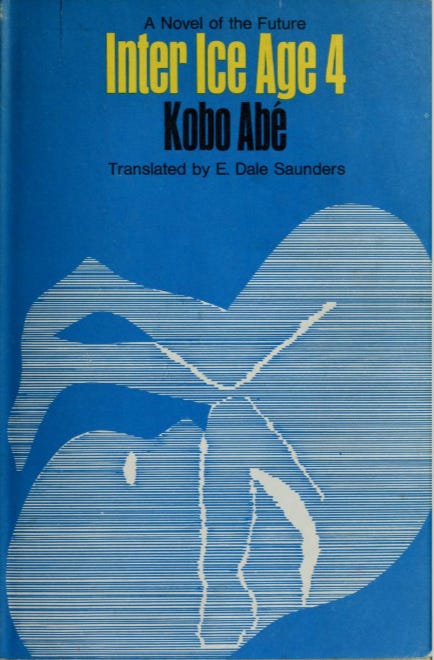
This is the twenty-fifth chapter in a long-simmering miniseries called “Narrative Architecture” about storytelling choices in fiction. There are many ways to tell a story, and in this series, I’ll examine the literary choices a particular author made and their impact on the story at hand. This week, I’ll engage with Kobo Abe’s Inter Ice Age 4, an early example of a climate thriller from Japan, currently out of print in the United States. (There are spoilers, so come back here later if you intend to read this book).
This post is a revised version of an essay I composed as part of my MFA program at UNR. You might also enjoy my related essay in Ploughshares on Inter Ice Age 4, which I published in 2021.
“I decided to try to grasp the image of a future that intrudes on the present, a future that sits in judgment,” wrote Kobo Abe in the postscript of his novel, Inter Ice Age 4 (Abe 209). I’ve been thinking about this quote a lot in terms of understanding the purpose of Abé’s climate-centric thriller. In this case, Abe—a Japanese novelist better known for his existentialist or Kafkaesque works which were made into landmark films by Hiroshi Teshigahara (such as The Woman in the Dunes and The Face of Another)—wrote a novel which feels more pulpy, propulsive, and speculative; I’d describe Inter Ice Age 4 as a mashup between the suspense sensibilities of Michael Crichton and the mind-bending qualities of Philip K. Dick. Much of the book’s runtime is devoted to thriller-y elements and surprise reveals and reversals, but all that builds to a climactic moment of even greater revelation on the scale of a Man in the High Castle-cliffhanger ending. Despite its odd title, Inter Ice Age 4 is not a sequel Inter Ice Age 3, but a short novel serialized over nine months in Sekai Magazine, a monthly politically-progressive magazine in Japan. In novel form, this amounts to essentially two narrative sections that comprise about 22 and 25 short chapters, respectively. Astonishingly, though this novel is not often discussed today, it has been identified as one of Japan’s first “hard sci-fi” novels, and probably one of the earlier examples of “cli-fi” more generally.
The premise starts out simple enough: Tokyo-based university professor Katsumi is in charge of a computer which can forecast the future. But because a Soviet forecasting computer keeps making political predictions that Communism will prevail over liberal democracies, Katsumi decides to avoid politics and program his machine to forecast the future of an individual human being. Assisted by his employee, Tanomogi, they select a man at random for the experiment, but this man is mysteriously murdered. After several reversals and surprises, we learn that Tanomogi is really an agent of a cabal of government scientists who are supervising the genetic engineering of a race of human hybrids with gills, known as aquans. They are doing this because the melting polar ice caps will lead to a rise in sea levels; rather than solve the problem of climate change directly, they figure it is better to design the successor to homo sapiens.
If that wasn’t bonkers enough, they also abort the unborn child of Katsumi’s wife (?!) so that they can genetically engineer the fetus to become an aquan. By stealing fetuses on a massive scale they have produced the necessary population base for the aquan race, and also given regular humans empathy with an alien race since they are genetically their children. Furthermore, by creating an aquan that is technically a son of Katsumi, he is implicated in the scheme which makes it harder for him to rebel against it. The novel ends on a surreal note as the forecasting computer predicts what will become of the aquan race, featuring a scene of a young aquan who, curious about his past, swims around the sunken ruins of Tokyo and dies on dry land (evoking the evolutionary cliché of the first amphibian that made the transition to land).
Not all the plot elements add up, and the abortion plotline is deeply weird and alarming, but Abe’s inventiveness and narrative dexterity comes to a forte in this very strange book. Notably Inter Ice Age 4 has two climaxes, the first a cliffhanger at the novel’s midway point, when Katsumi confronts Tanomogi and accuses him of murdering the man they were supposed to study. Like a private detective in a Dashiell Hammett novel, Katsumi systematically lays out Tanomogi’s motives:
If we assume for the moment that you are the murderer, a motive is simple to find. For instance, I met the murdered man quite by accident, but he might have been the one you were after from the beginning. That day we had no particular goal in mind, and we were exhausted too. It wouldn’t have been all that hard to get me to the café and bring my attention to the man you had previously lured out with the Kondo girl. You were very successful. You trapped me beautifully. You planned for me to fear the police, yet you managed to avoid suspicion yourself by pretending to co-operate in the pursuit of the criminal… What a pity to find yourself exposed by what you least expected. (Abe 83)
By this point of the book, we’re still in hardboiled mystery territory and not quite yet in the realm of science fantasy; the murder plotline is something out of The Thin Man or The Maltese Falcon, with Katsumi assuming the Sam Spade role in the archetypal moment when the detective lays out the logic of the case and explains how they found out the criminal. While this speech serves up what you might expect in a genre piece, I am in awe of it because it is only the first reveal. We’re only halfway through the book, and despite that Katsumi can solve some of the problems posed by Tanomogi’s involvement, he can’t solve every problem, because he is still in the dark about so much, adding to the helplessness of his situation. From this confrontation, Tanomogi views it important to bring Katsumi in on aspects of the plan which have thys far been hidden, enabling the last half of the book to explore the existence of before-unmentioned aquans.
Abe has provided a roadmap for how to fashion a double-reveal, though his reason for the staggered reveal is probably more to do with the fact that his novel was serialized. Thematically, there is something unsettling in the fact that the protagonist thinks he’s solved the case halfway through the story, but quickly learns he’s in way over his head. As Abe states in his postscript, he’s created a story where the “future” intrudes on the present, and forces his protagonist to come to terms with a destiny that is completely out of his control.
Once Katsumi is finally captured by the government scientists, they proceed to explain the aquan development and fetus-stealing scam, similar to how O’Brien explains the world order to Winston Smith in 1984 and Mustapha Mond elucidates the same to Bernard Marx in Brave New World. Abe spices up the presentation of this exposition by forcing his protagonist to watch a TV documentary about the creation of the aquans, presented in the novel as a script, a startlingly postmodern technique for the book’s publication in 1970:
–Sorry to have kept you waiting.
[A voice interrupts, and the screen grows light. Underneath the water in an enormous pool, as far as the eye can see, long shelves partitioned into small compartments stand side by side in many rows and on numerous levels. In each compartment aquan sucklings are floating in whatever position they please.]
–This is the nursing room, part of the infant-rearing division. They’re brought here directly from the delivery room; we exceed five hundred a day, on good days a thousand. It would be ideal to keep them here five months until they’ve weaned, but if we did that we’d have to provide berths for at least a hundred and twenty thousand… (Abe 169-170)
By mimicking the style of a public access documentary, Abe can explain the process of aquan development in a way that can also establish its credibility as a concept; make the scheme seem believable enough by having an “expert” explain the process, through dialogue and stage directions. It also speaks to the extent of the scheme, that the government is even producing videos about it.
Which leads us to the final section, where the forecasting machine explains to Katsumi what the future holds for the aquans. Abe tells this scene in summary, almost like the opening of a thriller, rather than the ending:
At fifteen thousand feet the thick mud of the lifeless sea floor was spotted with holes, and fluffy as if covered with the hair of some atrophied animal. Abruptly it heaved up. Instantly dispersing, it transformed itself into a dark, upward-welling cloud that wiped out the star points of plankton thronging over the diaphanous black wall. (Abe 194)
This augury signals the arrival of the mature aquans to the attention of the human race just as the titular “Fourth Inter Ice Age” concludes and precipitates rapid sea level rise. This scene builds into a future where the aquans gradually supplant the humans as the sea levels rise. One of the aquans feels a yearning to go ashore, and this is what transpires:
With the last of his strength the youth crawled up onto land. He had imagined that in order to hear the music of the wind he would have to stand upright on the land surface, but when he had crawled up he was unable to move and lay flat on the ground… it was all he could do to raise a single finger… He was happy. Perhaps these were tears, it occurred to him, obviously a land sickness. He no longer felt like moving. Soon he stopped breathing. (Abe 206)
In spite of its surreal nature, I find this scene strangely affecting, a metaphor for a future humanoid who mourns the loss of the Earth and dies for a taste of that past. This is the perfect moment which sums up what cli-fi as a genre is capable of addressing. Our protagonist Katsumi thinks, upon seeing this simulation: “Now I wonder if I can raise my own fingers, I mused. No, maybe not. Like those of the aquan youth who had crawled up on land, my fingers were asheavy as lead,” bringing in another dimension of reflection, as the man from the present mourns the death of the youth from the future (Abe 207). In this way, he is building out the theme of the novel spouted by Katsumi’s computer doppelgänger earlier in the novel (which I neglected to mention previously because the computer’s adoption of Katsumi’s identity is a minor reveal in the grand scheme of the book): “A crime against the future is different from one against the past or the present. It’s fundamental and definitive” (Abe 162). Human-caused climate change is a crime against the future, and by showing the death of the aquan, Abe can demonstrate how that crime plays out.
Inter Ice Age 4’s finale establishes a method for handling such grave moments, when a character realizes the world is ending and the future itself is doomed. In Abe’s postscript, he describes being “tormented” by the idea of the future:
The future, properly speaking, is already cruel by virtue of being the future… Yet I shall have fulfilled one of the purposes of this novel if I have been able to make the reader confront the cruelty of the future, produce within him anguish and strain, and bring about a dialogue with himself. (Abe, “Postscript” 209–210)
Inter Ice Age 4 succeeds as genre-bending climate fiction because Abe designed it to force readers to confront the consequences of their lifestyles and project those consequences onto a nightmare scenario, making the reader reconsider their daily actions. Few have done so as successfully as Abe did in this criminally-forgotten work.
Works Cited
Abé, Kobo and Saunders, E. Dale, (translator). Inter Ice Age 4 (Alfred A. Knopf: New York, 1970).
Japanese novelist is Kobe Abe is well-known for his Kafkaesque “The Woman in the Dunes.” But he should be better known for “Inter Ice Age 4,” the strangest climate thriller I’ve ever read, featuring fish-people and a malevolent AI.